

Article Takeaways
- TCPO reveals the real fulfillment cost behind misleading headline fees.
- Returns, surcharges, and internal management quietly erode ecommerce margins.
- Cheap 3PL quotes can hide higher storage, shipping, or exception costs.
- Receiving, storage, pick-pack, packaging, shipping, returns, VAS, WMS, labor shape TCPO.
Fulfillment cost is often misunderstood as a single line item on an invoice, yet for ecommerce brands, it is the primary variable determining contribution margin. Relying on a headline pick-and-pack fee to compare fulfillment setups is a common strategic error that hides the true cost of doing business.
In reality, profitability depends on calculating the total fulfillment cost per order – an all-in figure encompassing everything from inbound handling and storage to returns processing and internal management time.
This guide provides the framework to calculate these real costs, allowing you to normalize 3PL quotes and choose a model that supports predictable scaling.
What Counts as Fulfillment Cost?
When calculating the real cost of fulfillment, sellers look beyond the 3PL invoice. They categorize expenses into three main brackets:
- Core operational fees
- Variable logistics
- Fixed overhead
Core Fulfillment Cost Categories
An accurate cost-per-order figure is the sum of all expenses in the fulfillment lifecycle:
- Receiving and Inbound Handling: The labor tied to unloading, validating, scanning, and storing incoming inventory.
- Storage and Warehousing: The monthly rent, typically charged by the pallet, bin, or cubic foot.
- Pick and Pack: The labor cost for picking items and preparing orders for shipment.
- Packaging Materials: The physical cost of boxes, tape, dunnage, and branded inserts.
- Outbound Shipping: One of the biggest variable costs, largely shaped by carrier rates and dimensional weight pricing.
- Returns and Reverse Logistics: The cost to receive, grade, and restock returned items.
- Special Projects: Value-Added Services (VAS) such as kitting, labeling, or marketplace-specific prep.
Fixed vs. Variable Fulfillment Costs
The math’s not always the same: some fulfillment expenses increase with sales, while others exist no matter how many orders you get. You need to distinguish between costs that scale with order volume (variable fulfillment costs) and those that stand still (fixed fulfillment costs).
Costs like pick fees and shipping fluctuate with order volume. Unlike these, fixed costs stay the same no matter how many items you sell. They often include WMS software fees, minimum monthly service fees, and warehouse insurance.
Ignoring fixed costs can put pressure on your margins, especially during slow months.
The Hidden Costs of Exceptions
Many fulfillment costs are easy to miss because they don’t appear as primary line items. These include minimum monthly charges, peak season surcharges, and long-term storage penalties for slow-moving stock.
You must factor in internal management time. If your team spends time resolving shipping errors or managing 3PL communication, that labor is a fulfillment expense that directly impacts your bottom line.

How to Calculate Fulfillment Cost per Order
Based on estimated costs alone, you can easily end up miscalculating how much you’ll actually spend to get a product into a customer’s hands. The Total Cost per Order (TCPO) is the only accurate metric if you want to avoid margin leakage.

The Total Cost per Order (TCPO) Formula
TCPO is the sum of every dollar spent on fulfillment divided by the total number of successfully shipped orders:
(Total 3PL Invoice Costs + Total Internal Fulfillment Overhead) / Total Orders Shipped = TCPO
TCPO figure should include:
- Storage (monthly warehousing) costs
- WMS fees or integration software subscriptions
- Direct labor costs, including pick and pack fees, receiving costs, and special services like kitting and labeling
- The cost of packaging, inserts, and dunnage
- Outbound shipping charges, fuel surcharges, and return shipping
- Internal management hours, customer service time dedicated to logistics
- Exception handling fees (address corrections and re-ships)
Example Calculation
Let’s say you run a mid-sized brand shipping 2,000 orders per month with an Average Order Value (AOV) of $75. Your total cost breakdown would look like this:
| Cost Category | Monthly Expenses | Description |
|---|---|---|
| Pick & Pack | $5,500 | 2,000 orders (avg. 1.5 units per order) |
| Storage | $1,200 | 40 pallets/bin locations |
| Packaging | $1,600 | Custom boxes, tape, and branded inserts |
| Shipping | $14,000 | Outbound postage and surcharges |
| Returns | $1,500 | 8% return rate + processing labor |
| Management | $1,000 | Internal staff time (logistics oversight) |
| Fixed Fees | $500 | WMS platform fee and account management |
| Total Cost | $25,300 | Total monthly fulfillment spend |
The Margin View: Fulfillment as a % of AOV
Calculating the dollar amount is only the first step; the second is understanding how this affects your contribution margin. In the example above, a TCPO of $12.65 represents 16.8% of the $75.00 AOV.
If your product COGS (Cost of Goods Sold) is 40% and your marketing CAC (Customer Acquisition Cost) is 25%, a 16.8% fulfillment cost leaves a contribution margin of only 18.2%. If fulfillment costs spike due to unmanaged dimensional weight or high return rates, the margin quickly thins, leaving you with little to no cash flow to reinvest in growth.
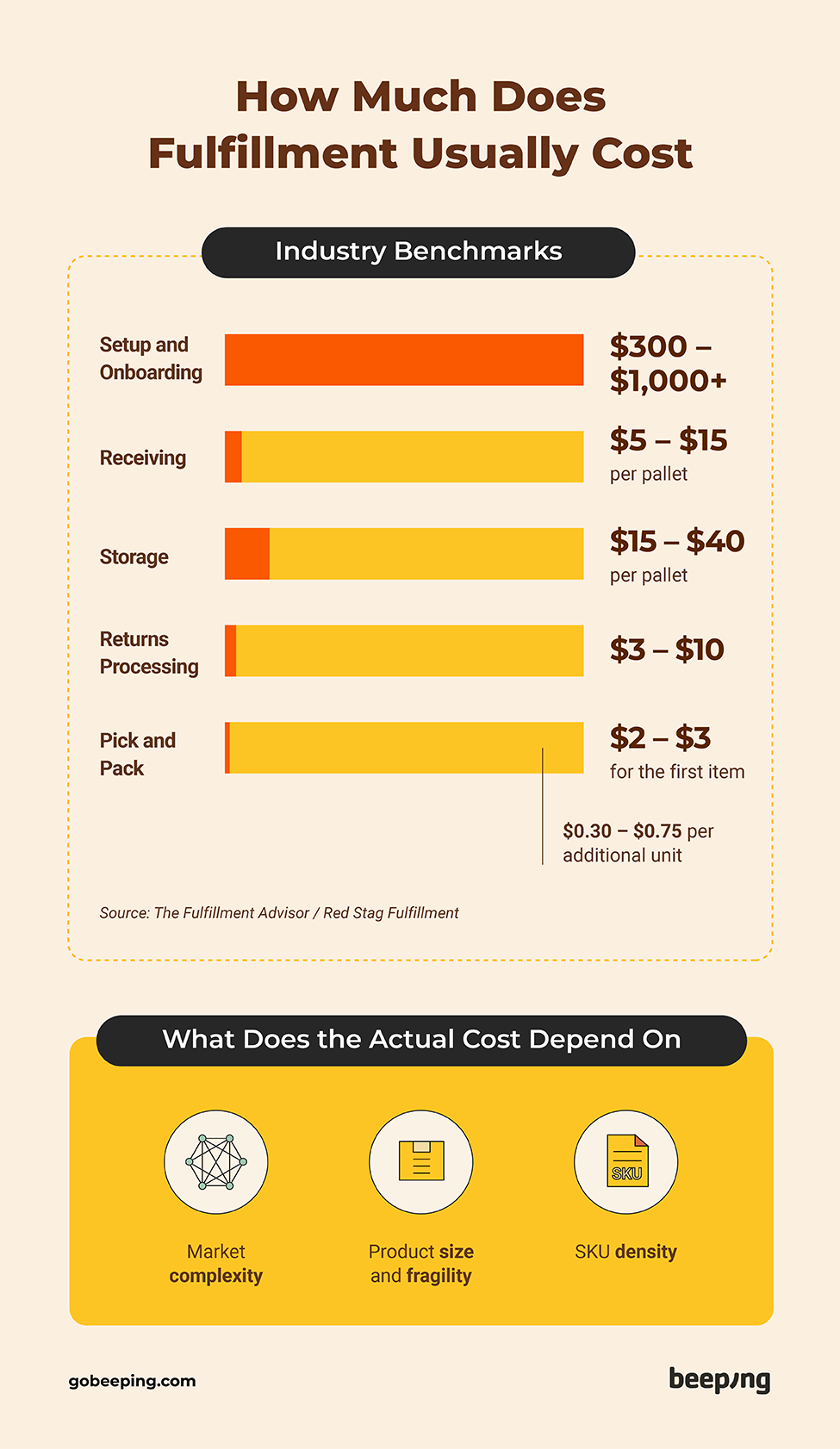
How Much Does Fulfillment Usually Cost?
The question of a typical fulfillment cost can only be answered by first defining the scope of a quote. Benchmark ranges are valuable for sanity-checking a 3PL proposal, but they are misleading if you do not know exactly which services are bundled into the headline rate.
A provider offering a $2.50 pick and pack fee may actually be more expensive than one charging $4.50 if the former includes packaging materials, receiving fees, and account management.
Use these benchmarks as a baseline:
- Setup and Onboarding: $300 – $1,000+ (The Fulfillment Advisor)
- Receiving: $5 – $15 per pallet (The Fulfillment Advisor)
- Storage: $15 – $40 per pallet (Red Stag Fulfillment)
- Pick and Pack: $2.00 – $3.00 for the first item; $0.30 – $0.75 per additional unit (The Fulfillment Advisor)
- Returns Processing: $3.00 – $10.00 (The Fulfillment Advisor)
These ranges help identify pricing outliers, but they are not universal. Actual cost will depend on the market, product fragility, and SKU density.
Brands with high order volume and simpler operations usually qualify for lower rates, while high-touch brands that rely on kitting, custom inserts, or specialized handling will naturally see higher totals.
Benchmarks can help you evaluate whether a quote is competitive, but keep in mind that a low per-line fee doesn’t automatically mean the lowest overall cost per order.
FREE 15-minute logistics review - Only this week
Show us how you handle warehouse and in 15 minutes we’ll show you where you’re losing margin or service, and if a 3PL like Beeping fits your case.
FREE 15-minute logistics review - Only this week
Show us how you handle warehouse and in 15 minutes we’ll show you where you’re losing margin or service, and if a 3PL like Beeping fits your case.
What Drives Fulfillment Costs Up or Down?
Two brands can have the same number of monthly orders and still pay two very different total fulfillment costs, because they fluctuate based on:
Product and Inventory Profile
Let’s start with storage and labor costs, because they are directly impacted by your inventory setup.
SKU complexity is one of the biggest factors here. Managing 500 SKUs is more expensive because it’s far more labor-intensive than managing 50. It requires more storage locations, tighter tracking, and better picking accuracy.
The size and fragility of your product matter, too. If your items are oversized, heavy, or delicate, you can expect higher shipping costs because of higher dimensional weight and protective packaging.
Slow-moving inventory can become a hidden margin drain, since long-term storage fees reduce the profitability of faster-selling products.
Order and Shipping Profile
The “pick density” of an order (how many items are included per box) also affects labor costs. Multi-SKU orders take longer to pick and require larger packaging. Costs can go up during peak season spikes with surcharges and temporary labor premiums.
Shipping distance is another major cost driver, as delivering orders across distant shipping zones increases postage.
Returns and Operational Complexity
Still, the most expensive touchpoint in fulfillment is returns. High return rates demand increased labor for inspection and grading, while also requiring additional customer service time.
Value-added services (VAS) such as kitting, bundles, custom packaging, or marketplace-specific relabeling introduce additional manual handling steps. These services can increase AOV and improve the customer experience, but they also raise the total fulfillment cost per order.

In-House Fulfillment vs Outsourced Fulfillment Costs
When comparing in-house operations to a 3PL, many brands make the mistake of only comparing a 3PL’s invoice to their own warehouse rent and payroll.
An in-house operation comes with a range of invisible expenses: utilities, equipment maintenance, insurance, packing software, and the management time required for supervision and training. Plus, you must factor in the opportunity cost of focusing on warehouse logistics instead of growth.
Financially, the main difference is the conversion of fixed costs into variable costs. An in-house setup carries high fixed overhead (rent and salaried labor) that must be paid regardless of order volume. Outsourcing converts much of this into a variable per-order expense, though it adds 3PL management fees.
| In-House Cost Category | Outsourced (3PL) Equivalent |
|---|---|
| Rent, taxes, and utilities | Monthly storage and account fees |
| Hourly labor and supervision | Pick and pack fees |
| Packaging and equipment leases | Material fees and markup |
| Software and API integrations | Platform and integration fees |
| Management time and training | 3PL account management fees |
Don’t decide based on what is cheaper in theory, but on which setup gives you a more sustainable cost per order and protects your margin at your current order volume and operational complexity.
How to Compare 3PL Fulfillment Quotes Properly
Comparing fulfillment quotes is often an exercise in frustration because no two providers structure their fees identically. To make a like-for-like comparison, normalize each proposal using the same data set.
This means asking every provider to quote you based on the same assumed monthly order volume, SKU count, average units per order, storage footprint, and return rate. Without this, a provider with a low headline pick-and-pack fee can hide higher costs in storage or shipping markups.
The Power of the Mock Invoice
The most effective way to get the real number is to request a mock monthly invoice that includes:
- Core Logistics: Pack and pack, storage, and outbound shipping.
- Account and Technology: Minimum monthly fees, platform access, and integration.
- Exceptions and Surcharges: Return processing, peak season multipliers, and labeling fees.
This forces the provider to account for all recurring operational costs.
The Final Comparison: Margin Impact
Stay focused on two metrics: total cost per order (TCPO) and fulfillment cost as a percentage of AOV.
A provider may offer a competitive pick fee but charge excessive packaging markups that neutralize your savings. But if you calculate the total impact on your contribution margin, you can identify which partner offers true operational efficiency.

How to Reduce Fulfillment Costs Without Damaging Customer Experience
Reducing fulfillment costs is about building operational efficiency:
- Optimize Packaging Efficiency: Save on dimensional weight and postage costs by using the smallest possible packaging.
- Improve Inventory Hygiene: Regularly clear out slow-moving stock to avoid long-term storage fees.
- Tier Shipping Service Levels: Match the delivery speed to the product’s margin by using standard ground for most orders and reserving express delivery for high-AOV purchases.
- Simplify Operational Complexity: Streamline kitting, bundling, and custom inserts to reduce the manual labor costs.
Conclusion
Fulfillment cost must be measured as total cost per order, not as isolated fees. To compare your options, use industry benchmarks to normalize 3PL quotes, request mock invoices, and evaluate the final impact on contribution margins and customer experience. Beware of the cheapest quote – it’s rarely the most profitable. The best fulfillment setup is the one that provides predictable costs and operational reliability, giving your brand the necessary margin to scale sustainably.
FAQs
In standard accounting, fulfillment is typically classified as an operating expense (OpEx). However, the best practice for ecommerce brands is to treat fulfillment as a variable cost within a fully loaded COGS model to accurately calculate the contribution margin.
"*" indicates required fields


